In the hyper-accelerated digital advertising landscape of 2026, relying on manual ad library searches is a recipe for falling behind. Competitors are constantly cycling through hundreds of multivariate creatives, micro-targeted variations, and dynamic generative assets across Meta, TikTok, Google, and LinkedIn. If your team is still taking manual screenshots and dropping them into shared folders, you are operating at a distinct disadvantage. This is why scaling your competitor ad monitoring is essential.
The democratization of multimodal artificial intelligence and no-code automation platforms has fundamentally shifted competitive intelligence. Today, performance marketers, creative strategists, and agency leads can construct fully autonomous competitor tracking pipelines in minutes—without writing a single line of code.
Here are the top five no-code AI tools transforming competitor ad monitoring in 2026.
Foreplay: The AI-Powered Creative Swipe Engine
While initially recognized as a high-utility swipe-file tool, Foreplay has evolved into an essential AI-driven competitive intelligence platform. By integrating directly with ad transparency repositories (Meta Ad Library, TikTok Creative Center, LinkedIn, and YouTube), it allows marketers to build persistent ad archives that do not disappear when a competitor pauses their spend.
Key AI Capabilities:
- Automated Storyboarding: The platform’s computer vision models deconstruct competitor video ads frame-by-frame, identifying visual hooks, transitions, and pacing metrics.
- AI Transcription and Hook Scoring: Automatically transcribes voiceover and on-screen text, running sentiment analysis and hook-retention predictions based on historical vertical benchmarks.
- Autonomous Briefing: In 2026, Foreplay doesn’t just show you what competitors are doing—it synthesizes their top-performing concepts into structured creative briefs ready for your production team.
Best For: E-commerce, direct-to-consumer (DTC) brands, and performance marketing agencies looking to systematically break down competitor creative frameworks.
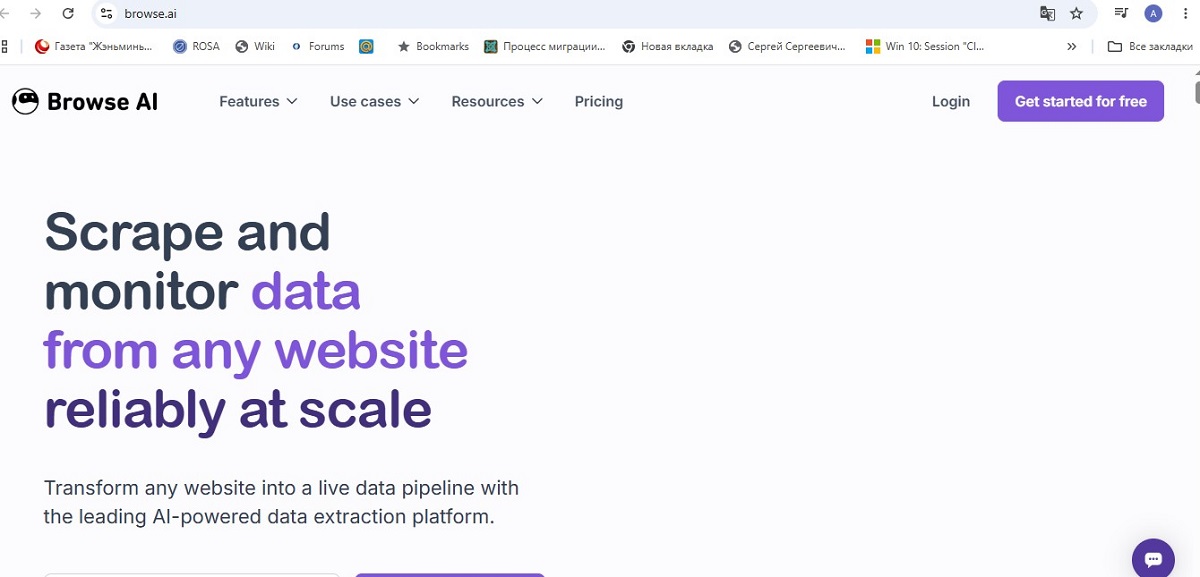
Browse AI: Autonomous Scraping for Dynamic Ad Libraries
Ad platforms constantly update their front-end interfaces to deter traditional web scrapers. Browse AI solves this with self-healing, zero-code web scraping robots powered by computer vision.
Users can train a monitoring bot simply by clicking around a competitor’s public ad library page. Browse AI learns the user pattern, accounts for DOM layout shifts, and continuously extracts creative assets, ad copy, and live dates on a predetermined schedule.
Key AI Capabilities:
- Self-Healing Selectors: If Meta or Google updates their CSS selectors or page layouts, Browse AI’s visual recognition models automatically adapt the extraction paths without breaking your workflow.
- Change-Detection Triggers: You can instruct the system to alert your team only when a competitor launches a fundamentally new creative angle or scales their active ad count past a specific threshold.
- Seamless Webhook Integrations: Automatically pipes raw media files and copy variations directly into Notion, Airtable, or your internal data warehouse.
Best For: Growth marketers needing custom, schedule-driven monitoring across niche networks or search ad results that lack dedicated tracking software.
MagicBrief: Creative Iteration and Funnel Deconstruction
MagicBrief focuses heavily on the mechanics of ad creative, making it a favorite among creative strategists. It continuously tracks competitor campaigns, organizes them into dynamic boards, and uses generative models to analyze ad lifecycles.
Key AI Capabilities:
- Fatigue and Longevity Tracking: MagicBrief highlights which ads have remained active the longest—a primary proxy for profitability and high spend.
- Component-Level Breakdown: The AI tags each asset by hook style (e.g., UGC, 3D render, founder interview), body angle (e.g., pain-point focus, social proof), and Call-To-Action (CTA).
- Script and Storyboard Regeneration: With one click, users can ingest a competitor’s winning script and generate differentiated, non-infringing variations tailored to their own product catalog.
Best For: Creative directors and video production teams who need to understand why a competitor’s creative is converting, rather than just seeing the final asset.
Axiom.ai: Browser Automation with Native Multimodal Vision
For competitor ad campaigns that live behind dynamic landing pages, localized regions, or interactive quizzes, traditional scrapers often fail. Axiom.ai bridges this gap by offering visual, no-code Robotic Process Automation (RPA) enhanced with multimodal AI.
Axiom mimics human browser behavior: it can navigate complex, JavaScript-heavy ad landing pages, click interactive elements, and capture personalized ad variations served based on location or interaction history.
Key AI Capabilities:
- Visual Text and Element Extraction: Instead of relying strictly on code paths, Axiom uses AI vision to identify buttons, headlines, and dynamic pricing elements on competitor landing pages.
- Full-Funnel Auditing: Automates the path from the initial ad click to the final checkout page, capturing every step of the competitor’s post-click experience.
- Anti-Bot Navigation: Simulates natural mouse movements and browsing intervals to prevent rate-limiting when auditing public ad libraries at scale.
Best For: Teams running sophisticated, multi-step customer acquisition funnels that need to monitor competitor post-click landing pages alongside their front-end ads.
Make + Multimodal LLMs: The Custom Autonomous Workflow
While dedicated SaaS tools are powerful, the gold standard for enterprise marketing agility in 2026 is building a proprietary, no-code automation pipeline using Make (formerly Integromat) paired with multimodal models like OpenAI’s GPT-4o or Google Gemini.
Using Make, you can trigger a workflow whenever a tool like Browse AI captures a new competitor ad. The workflow passes the ad image or video to an AI vision model with a custom prompt, analyzes the messaging strategy, and logs the insights into your centralized marketing dashboard.
Key AI Capabilities:
- Custom Strategic Classification: Train the AI on your specific market positioning to evaluate competitor messaging against your unique value proposition.
- Automated Weekly Executive Digests: Direct Make to analyze the week’s batch of competitor ads and output an executive summary via Slack or email, detailing shifts in competitor pricing, value propositions, and primary consumer hooks.
- Zero Vendor Lock-In: You retain 100% control over the data pipeline, storage architecture, and prompt engineering logic.
Best For: Advanced operations teams and agencies that require highly bespoke, automated reporting tailored to specific enterprise KPIs.
Quick Comparison: Top AI Competitor Ad Monitoring Tools in 2026
| Tool | Best For | Key AI Feature |
|---|---|---|
| Foreplay | E-commerce, DTC brands, and performance agencies. | Automated frame-by-frame storyboarding and AI voiceover transcription. |
| Browse AI | Custom, schedule-driven tracking across niche ad networks. | Computer vision-powered self-healing selectors that adapt to layout changes. |
| MagicBrief | Creative directors and video production teams. | One-click script and storyboard regeneration based on winning ads. |
| Axiom.ai | Multi-step marketing funnels and post-click landing page audits. | Multimodal AI vision to extract dynamic elements and mimic human browsing. |
| Make + LLMs | Advanced ops teams and enterprise agencies requiring bespoke reporting. | Custom strategic classification and automated weekly executive insights. |
Strategic Shift: How to Evaluate Ad Data in 2026
Ad monitoring in 2026 is no longer about imitation; it is about algorithmic pattern recognition.
When deploying these tools, focus your automation on three core signals:
- Creative Longevity: Filter out the noise by ignoring ads running for less than seven days. Prioritize tracking assets that have sustained spend for 30+ days.
- Iteration Velocity: Track how rapidly a competitor introduces variations of a single concept. High iteration frequency usually signals a high-converting core angle.
- Format Migration: Watch for cross-platform expansion. When a competitor ports a winning vertical video concept from TikTok into YouTube Shorts and Meta Reels, they have likely uncovered an omni-channel winner.
By implementing an automated, no-code AI stack today, you turn competitor ad libraries from passive public directories into a continuous stream of predictive, actionable growth data.