In the corporate world, deploying open-source LLMs for contract review and compliance validation solves some of the most labor-intensive bottlenecks. Legal teams spend thousands of hours parsing Master Services Agreements (MSAs), non-disclosure agreements (NDAs), and vendor contracts to flag non-standard clauses, verify regulatory compliance, and mitigate legal risk.
While proprietary Large Language Models (LLMs) like GPT-4 offer impressive zero-shot reasoning capabilities, legal data is uniquely sensitive. Uploading unredacted contracts, proprietary intellectual property, and confidential counterparty terms to third-party APIs often violates enterprise data protection mandates, GDPR, or client confidentiality agreements.
Deploying open-source LLMs within your own virtual private cloud (VPC) or on-premises infrastructure solves the data sovereignty dilemma. With recent open models matching or exceeding proprietary benchmarks in analytical depth, enterprise engineering and legal operations teams can now build autonomous, private, and highly accurate contract review engines.
Here is a comprehensive guide to architecting and deploying an automated contract review and compliance pipeline using open-source LLMs.
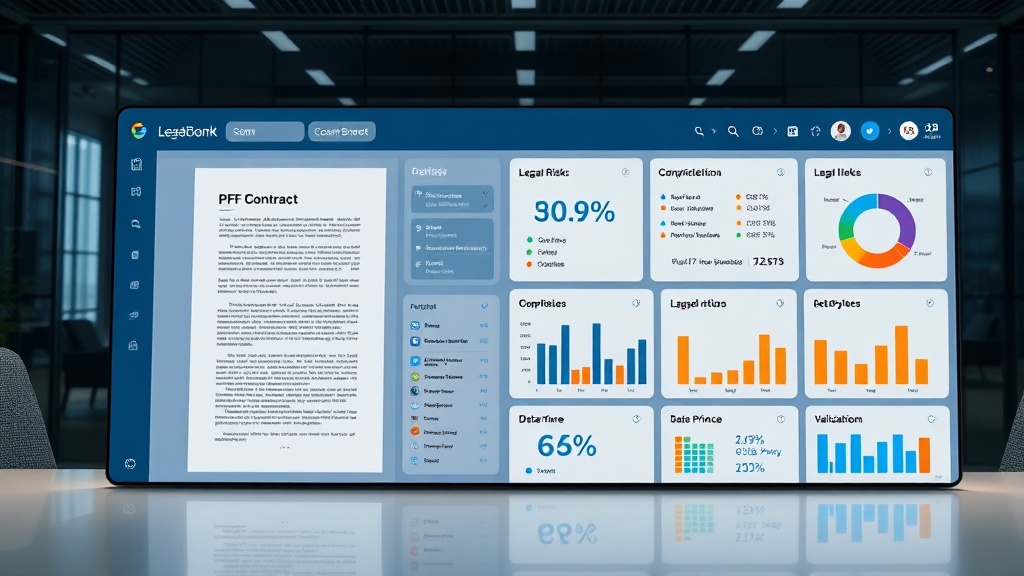
The Strategic Case for Open-Source LLMs in Legal Tech
Choosing open-source models over closed-source APIs for legal workflows is primarily driven by three factors:
- Absolute Data Sovereignty: Legal documents frequently contain material non-public information (MNPI), personal identifiable information (PII), and proprietary commercial terms. Hosting open-source models (such as Meta’s Llama 3 or Mistral) on private clusters ensures zero external data leakage and eliminates the risk of sensitive terms being used for model training.
- Domain-Specific Customization: Legal language (legalese) relies on distinct syntactic dependencies and precise definitions. Open-source models allow teams to perform Parameter-Efficient Fine-Tuning (PEFT/LoRA) on custom contract repositories and playbooks, significantly lowering hallucination rates on complex clauses.
- Predictable Cost at Scale: Processing multi-hundred-page commercial agreements via commercial API tokens becomes prohibitively expensive at scale. Self-hosted inference engines (using frameworks like vLLM or TGI) offer predictable operational expenditures and high throughput. Deploying open-source LLMs locally gives legal departments complete control over confidential client agreements.
Technical Architecture of an Automated Review Engine
Automating legal reviews requires more than simply feeding a 60-page PDF into an LLM prompt. Contracts demand structured extraction, context preservation, and deterministic validation. A production-ready architecture consists of five core stages:
 [Document Ingestion & OCR]
 ↓
 [Hierarchical Parsing & Clause Chunking]
 ↓
 [Hybrid RAG & Legal Playbook Retrieval]
 ↓
 [Open-Source LLM Extraction & Analysis]
 ↓
 [Deterministic Rule Engine & Output Validation]
 ↓
 [Human-in-the-Loop (HITL) Interface]
Document Ingestion and Layout-Aware Parsing
Contracts rely heavily on hierarchy: sections, sub-clauses, schedules, and exhibits. Traditional naive chunking breaks cross-referencing logic (e.g., “Subject to Section 14.2…”).
- Use layout-aware tools such as Docling, Unstructured, or Surya OCR to retain bounding boxes, tables, numbering hierarchies, and headers.
- Extract metadata per clause, including Section Number, Clause Heading, and Document Parentage.
Clause Segmentation
Instead of splitting text by arbitrary token counts (e.g., 512 tokens), segment documents structurally by individual clauses. Each clause serves as an atomic unit of evaluation against your compliance criteria.
Selecting the Right Open-Source Model
Context window length, instruction-following fidelity, and reasoning capabilities are critical metrics when choosing an open-source model for legal tasks:
- Llama 3.1 (8B, 70B): The 70B variant is the gold standard for open-source legal reasoning, featuring a native 128k context window that allows ingestion of entire agreements along with cross-referenced schedules. The 8B model is exceptionally efficient for simple extraction tasks and classification.
- Mistral Small / Mixtral 8x22B: Excellent instruction adherence and structured JSON generation. The mixture-of-experts (MoE) architecture provides fast inference speeds without sacrificing analytical depth.
- SaulLM-7B / Legal-Specific Models: Built specifically for legal text, domain-adapted models like SaulLM demonstrate higher baseline familiarity with common-law concepts, statutory definitions, and contract drafting conventions.
For enterprise production environments, Llama 3.1 70B Instruct (quantized via AWQ or GPTQ for cost-efficient deployment on enterprise GPUs like NVIDIA A100 or H100) balances top-tier reasoning with manageable infrastructure requirements.
Implementing Compliance Checks via Hybrid RAG
A contract cannot be reviewed in a vacuum; it must be audited against a baseline—typically your organization’s internal Negotiation Playbook or external regulatory mandates (e.g., GDPR, HIPAA, SOC 2, DORA).
Hybrid Retrieval-Augmented Generation (RAG) pipeline bridges this gap:
- Vector & Lexical Search: Combine dense vector retrieval (using models like `bge-large-en-v1.5` with vector databases like Qdrant, Milvus, or pgvector) with BM25 lexical search. This ensures precise keyword matching (e.g., finding the exact phrase “aggregate liability”) while capturing semantic intent.
- Context Injection: When evaluating a specific clause (e.g., Governing Law & Jurisdiction), retrieve the corresponding playbook entry (e.g., “Acceptable: Delaware, New York. Unacceptable: California, international jurisdictions without GC sign-off”).
- Cross-Document Reconciliation: In multi-document reviews (e.g., MSA + SOW), pass the Master terms alongside the SOW terms to identify direct conflicts in payment terms, intellectual property vesting, or termination notices.
Enforcing Structured Outputs and Deterministic Rules
The primary risk in automated legal workflows is model hallucination or ambiguous commentary. The LLM must not act as a casual chatbot; it must act as a strict analytical engine.
Utilize libraries such as Instructor or Outlines to force the LLM to output valid JSON matching a predefined Pydantic schema:
from pydantic import BaseModel, Field
from typing import Literal, List
class ClauseAudit(BaseModel):
    clause_type: str = Field(description="e.g., Limitation of Liability, Indemnification")
    verbatim_text: str = Field(description="The exact text extracted from the document")
    risk_level: Literal["Low", "Medium", "High", "Critical"]
    compliance_status: Literal["Compliant", "Non-Compliant", "Requires Legal Review"]
    identified_issues: List[str] = Field(description="Specific deviations from company playbook")
    suggested_redline: str = Field(description="Recommended fallback language")
Enforcing strict schemas enables direct integration with downstream software—such as updating your CLM (Contract Lifecycle Management) platform, sending alerts in Slack for critical risks, or rendering inline diffs in a web UI.
Integrating Human-in-the-Loop (HITL) and Redlining
Automating contract review does not mean removing legal professionals. Rather, it converts the legal team’s role from manual line-by-line reading to exception-based escalation review.
A resilient production workflow requires:
- Confidence Scoring: If the LLM’s confidence falls below a set threshold on an ambiguous indemnity clause, flag it for immediate manual review.
- Auditability: Every flagged issue must link directly to the verbatim source text in the original document with precise character offsets or page references.
- Automated Redlining: By generating standardized fallback language, the system can draft redlines using `python-docx` directly onto the counterparty’s document, presenting the attorney with a ready-to-approve markup.
Moving from Pilot to Production
To successfully deploy an open-source LLM contract review engine:
- Start Narrow: Begin with high-volume, standardized agreements (such as mutual NDAs or vendor data processing agreements) before tackling bespoke commercial contracts.
- Benchmark with Golden Datasets: Build an internal evaluation dataset of 50–100 historical contracts reviewed by senior legal counsel to measure your pipeline’s precision, recall, and false-positive rates.
- Optimize Inference: Use high-performance inference servers like vLLM with continuous batching and PagedAttention to minimize latency and maximize throughput across your GPU footprint.
By deploying open-source models within a secure, RAG-augmented architecture, enterprises can compress contract turnaround times from days to minutes while keeping their most sensitive data firmly within their own control. While building private pipelines with open-source LLMs secures data privacy, combining these models with specialized automated AI legal assistants delivers a comprehensive, enterprise-grade corporate governance framework. Ultimately, adopting open-source LLMs transforms slow manual compliance reviews into fast, auditable internal workflows.